
Table of Contents
- Gummy Supplements vs Capsules: What Actually Differs
- Are Gummy Vitamins Effective? What the Evidence Shows
- Gummy Vitamin Absorption: How Format Affects Nutrient Delivery
- Dose Accuracy, Stability and Shelf Life
- Gummy Vitamins Sugar Content and Added Ingredients
- How to Read Supplement Labels Before You Buy
- Safety, Interactions and Getting the Dose Right
- Conclusion: Choosing Between Gummies and Capsules
- Frequently Asked Questions
Last Updated: October 12, 2026
Gummy Supplements vs Capsules: What Actually Differs
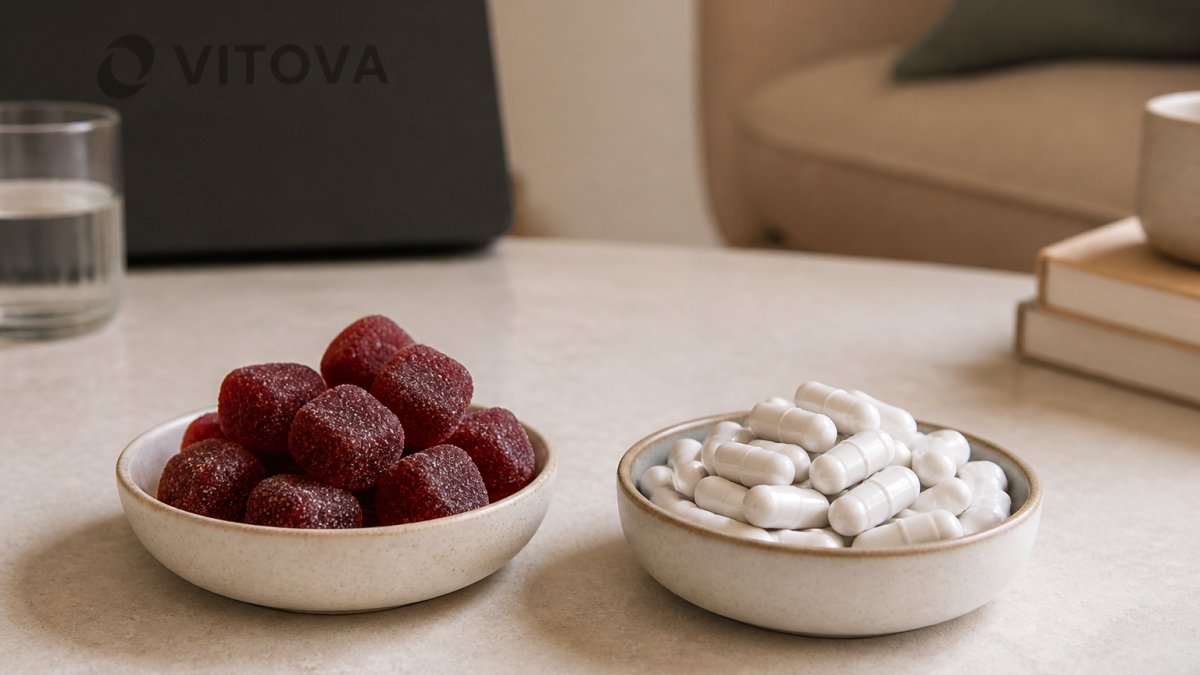
The gummy vs capsules question comes down to three things: what is in the product, how well the nutrients survive manufacture and storage, and whether the format suits your routine. Gummies win on taste and convenience. Capsules usually win on dose accuracy and shelf life. This guide explains how to judge both formats on evidence, not marketing.
The two formats are not interchangeable. A capsule is a shell filled with powder or liquid. A gummy is a moulded sweet, so its recipe needs gelling agents, sugar or sweeteners, flavours and colours. Those extras take up room that nutrients would otherwise fill.
That single fact drives most of the differences below. Below, we break down absorption, dose accuracy, sugar content and label reading, so you can pick the format that fits your needs.
Format comparison at a glance
| Feature | Gummies | Capsules |
|---|---|---|
| Ease of swallowing | Very easy | Can be harder |
| Taste | Sweet, flavoured | None or slight |
| Dose accuracy | Harder to control | Easier to control |
| Added ingredients | Often sugar or sweeteners | Fewer, usually |
| Shelf life | Shorter | Longer |
| Nutrient density | Lower per unit | Higher per unit |
| Best for | Routine adherence | Precise dosing |
Are Gummy Vitamins Effective? What the Evidence Shows
Gummy vitamins can be effective, but the evidence base is thinner than the marketing suggests. Most studies on nutrient absorption use capsules, tablets or powder, not gummies. Results from those formats do not always carry over.
The honest position is that a well-made gummy can deliver its nutrients, while a poorly made one may not. The format is not the deciding factor. The recipe, the dose and the testing behind it are.
Where study evidence is weaker than marketing suggests
Many claims about gummies rely on research done on other formats. A study on magnesium capsules tells you about magnesium capsules, not about a gummy containing magnesium. That gap matters when a brand implies strong proof.
Gummy Vitamin Absorption: How Format Affects Nutrient Delivery
Gummy vitamin absorption depends on how quickly the gummy dissolves and releases its nutrients. A gummy that dissolves slowly may release its contents unevenly. A capsule that breaks down on schedule delivers a more predictable dose.
Several factors shape absorption beyond format:
- Dissolution speed: how fast the product breaks down in the gut
- Nutrient form: some forms are easier for the body to take up
- Food and timing: taking a product with or without food changes uptake
- Your own digestion: individual differences matter
The format sets the starting point, not the finish line. According to NHS guidance on vitamins and minerals, how and when you take a supplement affects how your body uses it.
Dose Accuracy, Stability and Shelf Life
Dose accuracy and stability are the two areas where the format genuinely changes what you get, so it is worth understanding why rather than accepting a slogan.
Why capsules usually dose more tightly. A capsule is filled by weight on a machine that measures powder or liquid into each shell. The fill weight is the dose, and modern equipment holds that weight within a narrow tolerance. A gummy is poured as a liquid mix into a mould, then dried. Water evaporates during drying, the sweet shrinks, and any unevenness in the mix or the mould carries through to the finished piece. The active ingredient is also distributed through a much larger mass of base, gelling agent, sweetener, flavour, colour, so a small mixing error spreads across the whole batch rather than sitting in one place.
Why stability differs. Heat, moisture and oxygen degrade many nutrients over time. A capsule shell is a relatively dry, sealed environment that limits exposure. A gummy is a soft, water-containing matrix, often packaged in a pouch or tub that is opened repeatedly. Every opening lets in humid air. Nutrients that are sensitive to moisture, certain B vitamins, vitamin C and some probiotic strains, tend to lose potency faster in that environment.
The nutrient-by-nutrient caveat. Format performance is not uniform across ingredients, and this is where most comparisons oversimplify:
- Fat-soluble vitamins (A, D, E, K): absorbed with dietary fat regardless of format, so the meal you take them with often matters more than the shell.
- Water-soluble vitamins (B group, C): more exposed to moisture-driven degradation in a gummy, so overage and packaging quality matter more.
- Minerals (magnesium, zinc, iron): generally stable in both formats, but the form used (for example citrate versus oxide) affects absorption far more than gummy-versus-capsule.
- Botanical extracts (ashwagandha, and similar): stability depends heavily on the extract's standardisation and how it is protected in the base, not on the format alone.
What this means when you buy. A well-made gummy can hold its label claim to the end of shelf life; a poorly made capsule can fail it. The format sets the difficulty, not the outcome. Two practical checks:
- Look for a stated amount per serving on the nutrition or supplement information panel, not just an ingredient name.
- Check the storage instructions and the expiry date, and follow them. Cool, dry, tightly closed storage slows degradation in both formats.
If you take a gummy daily for months, treat storage as part of the dose. A pouch left open on a warm windowsill is not the same product as one kept closed in a cool cupboard.
Gummy Vitamins Sugar Content and Added Ingredients
Gummy vitamins sugar content is the trade-off most buyers overlook. Sugar, glucose syrup or sweeteners give gummies their texture and taste. That is fine in small amounts, but it adds up if you take several gummies a day.
Added ingredients also take space. Binders, fillers, flavours and colours all compete with the nutrients for room in each sweet. The result is often a lower nutrient concentration per unit than a capsule of the same size.
How to Read Supplement Labels Before You Buy
Reading a label well is a skill, and it is the single most useful thing you can do before spending money on any format. Most competitors tell you to "check the label"; here is a method you can actually apply.
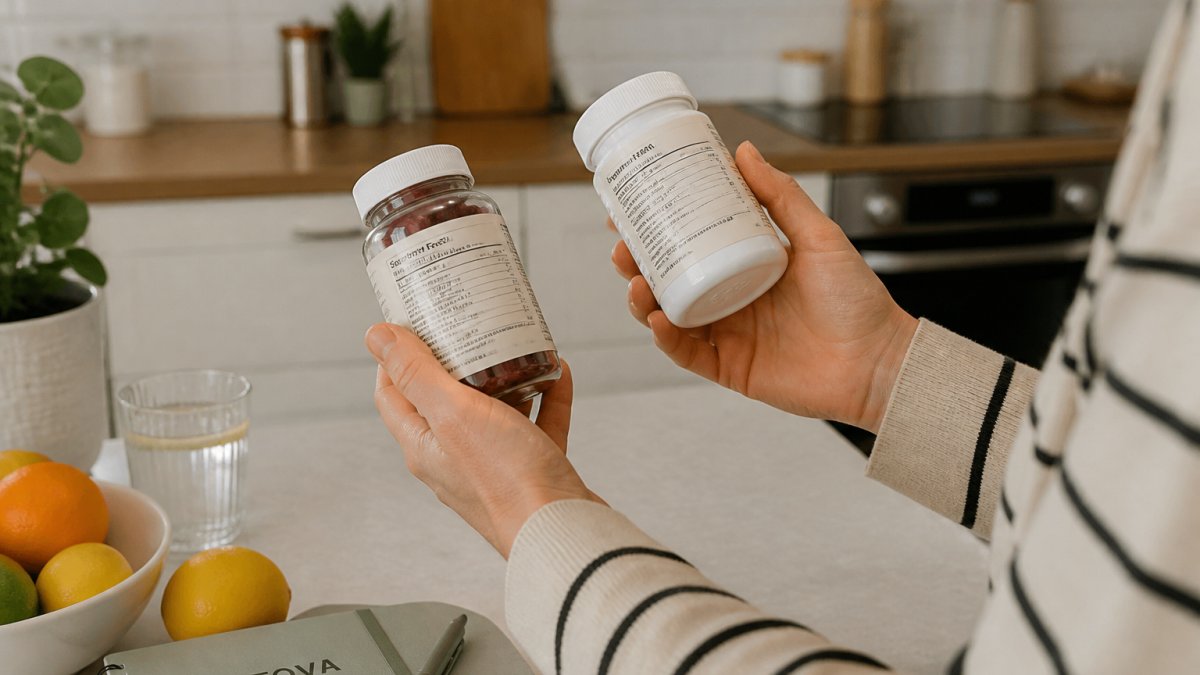
Step 1, Find the amount per serving, not the ingredient name. A label that lists "magnesium" without a figure tells you nothing about dose. Look for a number and a unit (mg or µg) against each nutrient. If the figure is missing, the product cannot be assessed.
Step 2, Check the serving size against the pack. If a serving is two gummies and the pouch holds sixty, that is thirty servings. Compare that with how many capsules count as a serving.
Step 3, Read the ingredients list in order. Ingredients are listed by weight, heaviest first. If sugar, glucose syrup or a sweetener appears above the nutrients you care about, the base dominates the recipe.
Step 4, Identify the nutrient form. "Magnesium" is not a form; magnesium citrate, magnesium glycinate and magnesium oxide are. The form affects how well the nutrient is absorbed and how it sits with your digestion. The same applies to zinc, iron and B vitamins. A label that names the form is more informative than one that does not.
Step 5, Look for how the brand verifies its claims. This is the gap most articles skip. There is no single UK logo that means "independently tested", so you have to read for signals:
- Does the brand state that finished products are tested, and against what, potency, heavy metals, microbial safety?
- Does it name the laboratory or the standard used, or only say "lab tested"?
- Does it publish a certificate of analysis or batch documentation on request?
- Does the label match the website's stated amounts exactly?
A brand that answers these clearly is easier to trust than one that repeats "premium quality" without specifics. Absence of detail is not proof of a bad product, but it is a reason to ask before committing to a long-term routine.
Step 6, Check the claims against the rules. In the UK, nutrition and health claims on food supplements must be authorised, and the Food Standards Agency sets out how supplements are regulated. General advertising of medicines and medical devices falls to the MHRA.
The label tells you what the maker claims. Testing and transparency tell you whether the claim is credible. Ask for both before you commit.
Safety, Interactions and Getting the Dose Right
Safety comes down to dose and interaction, not format. More is not better with supplements. Some nutrients build up in the body, and taking too much can cause problems.
A few practical rules:
- Stick to the stated dose unless a professional advises otherwise
- Check for overlap if you take more than one supplement
- Speak to a pharmacist or GP if you take prescribed medication
- Treat gummies like medicine, not sweets, and keep them out of reach of children
If you are unsure whether a product suits you, ask a qualified professional. General information is not a substitute for personal advice.
Conclusion: Choosing Between Gummies and Capsules
The gummy vs capsules choice is really a choice between adherence and precision. Capsules offer tighter dosing and longer shelf life. Gummies offer a routine you will actually keep, which matters if a capsule sits untouched in a cupboard.
For many people juggling a demanding schedule, the format you take every day beats the one you skip. That is the thinking behind Vitova Calm, a daily gummy that fits a busy routine. It comes as a simple two-gummy ritual, with a 30-day supply per pouch, built on a five-ingredient formula: magnesium, ashwagandha, L-theanine, zinc and vitamin D3.
If convenience is what keeps you consistent, a gummy may be the better fit. View the verified product details for Calm to see the full formula and decide for yourself.
Frequently Asked Questions
Are gummy supplements as effective as capsules?
It depends on the nutrient and the product. Some vitamins and minerals are easier to formulate into tablets or capsules at a precise dose, while others are widely used in gummies. What matters most is whether the label states a clear dose per serving and whether the manufacturer follows good quality control. A well-made gummy can be an effective option; a poorly formulated capsule may not be. Check the label rather than assuming one format is always better.
Do capsules absorb better than gummy supplements?
Not automatically. Absorption depends on the nutrient's form, the rest of the formula, whether you take it with food, and your own digestion. A capsule that dissolves quickly may release its contents faster, but a gummy that is chewed and swallowed is also broken down in the digestive tract. There is no single rule that capsules always absorb better. Look for products with clear dosing and, where available, evidence that the specific nutrient form is well absorbed.
What should I check on a gummy supplement label?
Start with the dose per serving, not just the ingredient list. Check how many gummies count as one serving, the amount of each active ingredient, and whether the label uses a recognised unit such as mg or micrograms. Look at sugars and sweeteners per serving, any allergens, and the storage instructions. If a claim on the front is not supported by the amounts on the back, treat it with caution. A label that is clear and specific is usually a better sign than one that is vague.
Are gummy supplements suitable for daily use?
Many people take gummies daily, and for some nutrients a daily gummy fits easily into a routine. The key is not to exceed the stated dose and to avoid doubling up on the same nutrient from several products. If you take other supplements or prescribed medicines, check with a pharmacist or doctor before adding another. Gummies are not automatically safer than tablets just because they taste like sweets, and some nutrients can build up if taken in excess.


Leave a comment
This site is protected by hCaptcha and the hCaptcha Privacy Policy and Terms of Service apply.