
Table of Contents
- Start With a Plan for an Anxiety Spike
- Breathing Exercises for Anxiety You Can Use Anywhere
- Grounding Techniques for Anxiety That Bring You Back to the Room
- Daily Habits That Help You Calm Anxiety Naturally
- How to Help Someone With Anxiety
- When to Seek Help for Anxiety
- Where Supplements Fit, and What They Can't Do
- Conclusion
- Frequently Asked Questions
Last Updated: October 19, 2026
Start With a Plan for an Anxiety Spike
Learning how to calm anxiety naturally starts with knowing what to do in the first sixty seconds. An anxiety spike is a sudden surge of worry and physical tension. It usually peaks fast, then fades. Having a short plan ready means you are not trying to think clearly while your body is in alarm mode.
A simple spike plan, in order:
- Name it out loud: "This is a spike, not an emergency."
- Slow your out-breath so it is longer than your in-breath.
- Press both feet flat on the floor and feel the contact.
- Pick one thing you can see, hear and touch.
- Give it ten minutes before making any decision.
That last step matters. The NHS guidance on anxiety, fear and panic notes that panic feelings usually pass without harm, which is worth remembering mid-spike.
Breathing Exercises for Anxiety You Can Use Anywhere
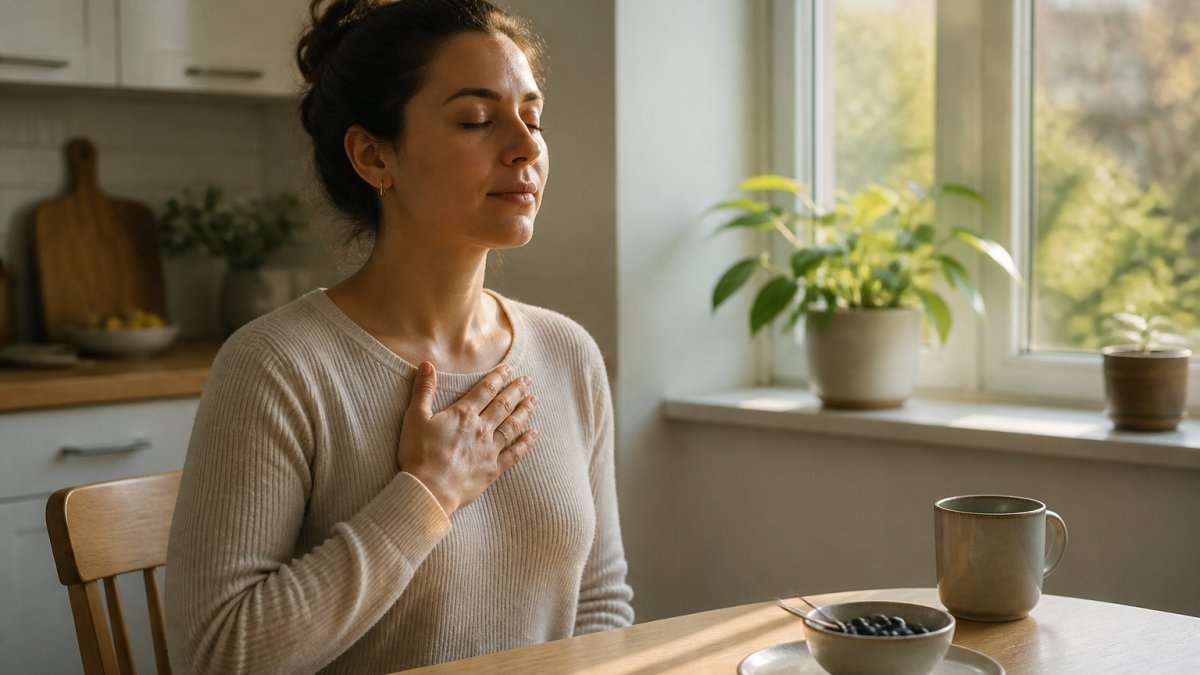
Breathing exercises for anxiety work because slow, steady breathing signals to your body that the threat has passed. The key is the out-breath. Make it longer than the in-breath, and keep it gentle rather than forced. The NHS guidance on breathing exercises for stress sets out a simple slower-breathing routine you can follow.
Which technique to use, and when
Not every breathing pattern suits every moment. Use this quick decision guide:
- Racing thoughts, mind won't slow: extended exhale (in for four, out for six). The longer out-breath is the priority; skip breath holds if they make you tense.
- Physical tension, tight chest or shoulders: diaphragmatic breathing lying down first, with one hand on your belly and one on your chest. Aim for the belly hand to rise more.
- Panic-like symptoms, feeling faint or dizzy: keep it gentle and short. Two or three slow breaths, then stop and ground yourself (see the next section). Forced deep breathing can lower carbon dioxide too far and worsen light-headedness.
- Anticipatory worry before an event: box breathing (in for four, hold for four, out for four, hold for four) for five rounds, done sitting upright. The structure gives your attention somewhere to land.
The two core techniques
- Box breathing: in for four, hold for four, out for four, hold for four. Repeat five times.
- Extended exhale: in for four, out for six. Repeat ten times.
Diaphragmatic breathing, where the belly rises rather than the shoulders, tends to feel calmer than chest breathing. Many people find correct breathing easier lying down first, then sitting, then standing.
Realistic expectations
Breathing is a skill, not a switch. Most people notice a small shift within a minute or two of practice, but the effect is modest and short-lived, it lowers arousal in the moment rather than resolving ongoing anxiety. Practising daily when you are calm makes the technique easier to reach for when you are not.
Grounding Techniques for Anxiety That Bring You Back to the Room
Grounding techniques for anxiety pull your attention away from spiralling thoughts and back to your surroundings. They work best when they use your senses rather than your thinking.
The 5-4-3-2-1 method is the easiest to remember: name five things you can see, four you can hear, three you can touch, two you can smell, and one you can taste.
Other options:
- Press your palms together firmly for ten seconds.
- Hold something cold, like a glass of water.
- Describe one object in detail, out loud.
- Move to a different room and notice what changes.
Body scanning helps too. Slowly move attention from your feet to your head, noticing each area without trying to fix it.
Daily Habits That Help You Calm Anxiety Naturally
Daily habits do more for anxiety than any single technique used in a crisis. The aim is a steady baseline, not a perfect routine.
What tends to help:
- Movement: a brisk walk, a swim, or a short session of yoga. Physical activity is one of the most consistent lifestyle factors linked with lower anxiety.
- Sleep: a regular wind-down and a consistent wake time, even after a poor night.
- Caffeine and alcohol: both can mimic or worsen anxiety symptoms, so track how you feel after them.
- Time and energy management: fewer commitments, planned properly, reduces the constant background pressure.
- Creative activities and peer support: both give your mind somewhere else to go.
The mental health charity Mind's pages on anxiety and panic attacks set out these self-care approaches in more detail.
How to Help Someone With Anxiety
Helping someone with anxiety starts with listening rather than fixing. Ask what would help right now, and accept the answer, even if it is "nothing".
Useful things to say:
- "That sounds really hard."
- "I'm here. Take your time."
- "Would it help to sit somewhere quieter?"
Less useful: "Just relax", "It's not that bad", or offering a diagnosis. Avoid pushing someone to talk about the cause mid-spike.
If they want practical support, offer something specific: a walk together, help drafting an email to their GP, or simply sitting with them.
When to Seek Help for Anxiety
Seek help when anxiety affects your work, sleep, relationships or daily life for weeks rather than days, or when you avoid things you used to do. You do not need to be at breaking point to ask for support.
Signs it is time to talk to a professional:
- Worry that feels hard to control most days
- Physical symptoms such as a racing heart, tight chest or stomach upset
- Avoidance that is shrinking your life
- Low mood, hopelessness, or thoughts of self-harm
Cognitive behavioural therapy is a common first-line talking treatment, and it is available through the NHS. Speak to your GP about what is available locally. If you feel unsafe or in crisis, contact emergency services or a crisis line straight away.
This article offers general information only. It is not a diagnosis or personal medical advice.
Where Supplements Fit, and What They Can't Do
Supplements sit at the edge of the picture, not the centre. They cannot treat anxiety, and no supplement should replace movement, sleep, talking therapy or medical care. What follows is a plain-English guide to the evidence and the safety questions worth asking before you buy anything.
Evidence strength, honestly graded
Natural does not mean proven. Broadly:
- Well-supported for general wellbeing: vitamin D and zinc have authorised nutrition claims for normal immune and bone function where the product meets the conditions of use. These are general health claims, not anxiety claims.
- Some research, mixed results: magnesium and L-theanine have been studied for relaxation and sleep quality, but study sizes are often small and findings inconsistent. Treat any benefit as modest and unproven for anxiety specifically.
- Less established: ashwagandha has attracted interest, but evidence is early-stage and long-term safety data are limited. It is not suitable for everyone (see below).
No supplement on the market is authorised to prevent, treat or cure any disease. If a label implies otherwise, treat that as a red flag.
Safety and interactions to check first
- Medication: some ingredients can interact with prescribed medicines, ashwagandha, for example, is not considered suitable alongside certain thyroid, sedative or immunosuppressant medications. Check with your GP or pharmacist before combining anything with prescribed treatment.
- Pregnancy and breastfeeding: many herbal ingredients, including ashwagandha, are not recommended. Seek advice before use.
- Health conditions: liver, kidney, thyroid and autoimmune conditions warrant a conversation with a clinician before adding supplements.
- Dose and duplication: check whether you are already getting an ingredient from a multivitamin, to avoid exceeding safe upper levels.
- Regulation: in the UK, supplements are regulated as food, not medicines, so claims on packs are restricted. Look for a clear ingredient list, stated amounts per serving, and a UK-based contact for the brand.
Reading a label before you buy
Compare products on four things: the amount of each active ingredient per serving (not just 'per gummy'), the full ingredient list including sweeteners and allergens, the serving size and pack duration, and any authorised health claims. A shorter, clearer label is usually easier to assess than a long 'proprietary blend'.
Where Vitova Calm fits
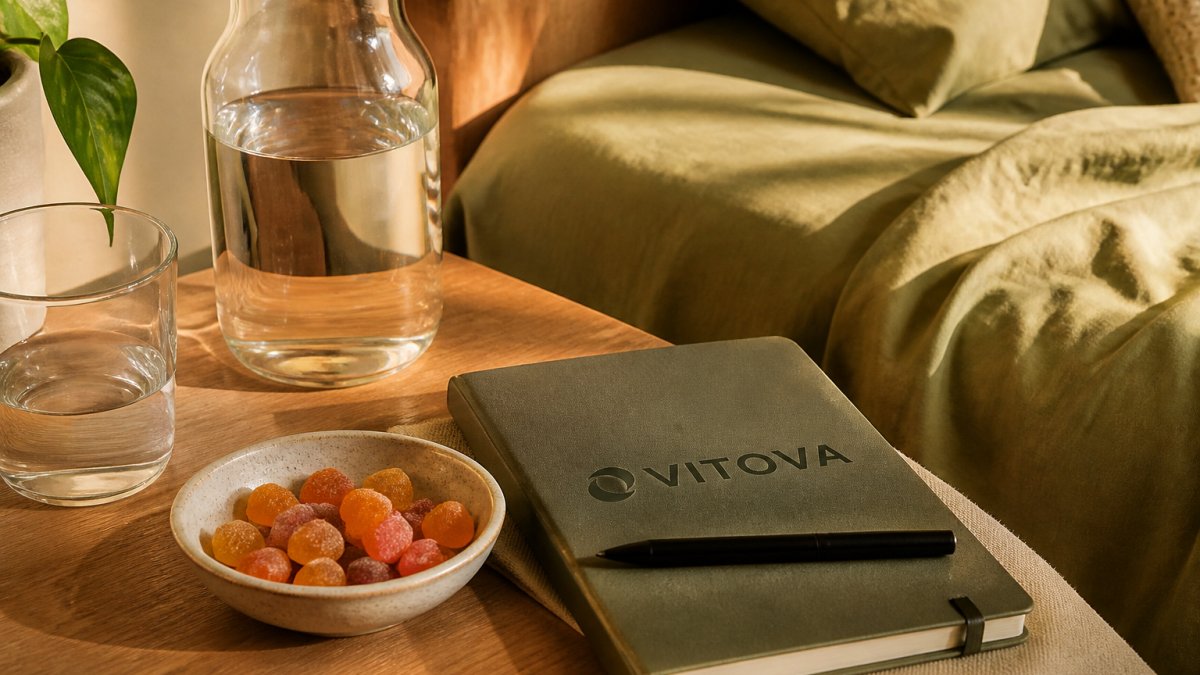
Vitova Calm is a daily gummy built around magnesium, L-theanine, ashwagandha, zinc and vitamin D3, taken as two gummies a day. It is designed as a simple routine, not a treatment. If you take prescribed medication, are pregnant or breastfeeding, or have a health condition, check with your GP or pharmacist before adding any supplement, as interactions are possible. You can view the full ingredient and product details before deciding whether it fits your routine.
Conclusion
Anxiety is manageable, but it rarely shifts through one technique alone. A spike plan, steady breathing, daily habits and honest support do most of the work, and professional help is there when self-help is not enough.
If a simple daily routine is part of what you are building, Vitova Calm offers a two-gummy ritual with magnesium, ashwagandha, L-theanine, zinc and vitamin D3, in a 30-day pouch. View the full ingredient and product details before deciding whether it fits your routine.

Frequently Asked Questions
How can I calm anxiety naturally in the moment?
Slow your breathing first: breathe in through your nose for a count of four and out for six, repeating for about two minutes. Then use a grounding technique, such as naming five things you can see and four you can hear. These steps won't remove anxiety, but they give your body something concrete to do while the spike passes. If spikes are frequent or intense, speak to your GP about further support.
What breathing exercises help when I feel anxious?
Diaphragmatic breathing is the most useful starting point. Place a hand on your belly, breathe in slowly so the hand rises, and breathe out for longer than you breathed in. Box breathing, with equal counts in, hold, out and hold, suits people who prefer structure. Practise when you're calm so the pattern is familiar when you need it. Stop if you feel dizzy and return to normal breathing.
When should I seek professional help for anxiety?
Consider speaking to your GP if anxiety affects your work, sleep or relationships, lasts weeks rather than days, or comes with panic attacks. Seek help sooner if you feel unable to leave the house, are avoiding situations you used to manage, or have thoughts of harming yourself. In the UK, NHS talking therapies such as cognitive behavioural therapy are available, and you can self-refer in most areas without seeing a GP first.
Can everyday habits help me manage anxiety?
Yes, though they work gradually rather than instantly. Regular movement, consistent sleep and waking times, limiting caffeine late in the day, and staying in contact with people you trust all support general wellbeing. Keep a simple note of what you tried and how you felt, so you can see patterns over a few weeks. Habits are a foundation, not a substitute for professional care if anxiety is significantly affecting your life.
Anxiety rarely responds to a single fix. Building a routine you can actually keep is the harder, more useful work, and it sits alongside the steps above rather than replacing them. Vitova Calm is a straightforward daily gummy with magnesium, ashwagandha, L-theanine, zinc and vitamin D3, made for people with demanding schedules. Explore the verified product details to see whether it suits your routine.

Leave a comment
This site is protected by hCaptcha and the hCaptcha Privacy Policy and Terms of Service apply.