
In the flight deck, we talk a lot about the difference between an acute problem and a chronic one. An engine fire is acute — checklist, act, done. Sitting on a five-day trip with three early alarms, two red-eyes and a body clock that hasn't known what time zone it's in for a fortnight — that's chronic. Different problem, different tool.
I've come to think of ashwagandha as a chronic-problem tool. Which is why so many people try it and give up in a week feeling nothing.
The gummies market is growing at nearly 20% a year in the UK for a reason — the ingredient works. But it works on a timescale that most wellness ads are actively lying about, and knowing what you're actually buying makes the difference between "worth the money" and "another scam." Here's the honest version.
Ashwagandha is a slow lever, not a switch
Caffeine works in 20 minutes. Melatonin works the same night. Ashwagandha does not work like either of those, and if you're taking it expecting it to, you're going to be disappointed.
It's what's called an adaptogen — a plant that gently retunes the body's stress-response system rather than acting like a switch. Its active compounds (withanolides) act on the HPA axis: the feedback loop between your brain and adrenal glands that decides how much cortisol you're pumping out.
In chronic stress, that loop gets stuck in the "on" position. Baseline cortisol runs too high, you feel wired-but-tired, sleep is light, mornings feel harder than they should. Ashwagandha's job — supported by a decent stack of clinical trials — is to dial that loop back down over weeks, not minutes.
The typical timeline across the trials looks like this:
- Week 1–2: sometimes slightly better sleep, subtle sense of less "on edge" — but honestly, easy to attribute to placebo
- Week 4: people who respond start to notice their mornings feel less frantic
- Week 6–8: the window where measurable changes in cortisol and stress scores actually show up in the studies
- Beyond 8 weeks: the curve plateaus — you're maintaining a lower baseline, not chasing a bigger one
If someone on my crew says "I've been on ashwagandha for four days and I feel nothing," my honest reply is: yeah, that's about right. Come back in six weeks.
The dose the ads don't want you to think about
Here's the number that gets buried in the marketing. For stress and cortisol outcomes, the doses used in the clinical trials sit in a fairly narrow band. Not "some ashwagandha." A specific range.
The most cited trials — including the landmark 60-day Chandrasekhar study — used 300 to 600 mg per day of a standardised root extract. Systematic reviews looking across the last decade land on the same range. The 27–30% cortisol reduction figure that gets thrown around online? That came from 600 mg/day for 60 days of KSM-66, a specific standardised extract.
Two words in that sentence do all the work: standardised and extract.
Walk down any Amazon supplement page and you'll see labels shouting "1,500 mg of Ashwagandha!" That's usually ashwagandha root powder, not a standardised extract — and it isn't remotely equivalent. Extracts concentrate the withanolides so a smaller dose delivers more of what actually works. Trials used named extracts like KSM-66, Sensoril or Shoden precisely because the researchers needed to know exactly what the body was getting.
It reminds me a bit of aviation fuel maths. Two aircraft can both be carrying "5,000 kg of fuel," but if one is Jet A-1 and the other is diluted with water, the numbers on the paperwork are meaningless. What matters is what's actually in the tank, and how much of it is fuel. Same with ashwagandha: the milligrams on the front of the pack are marketing until you know what's inside them.
Three things to check on a gummy label before anything else:
- Is it a standardised extract, or just root powder?
- What's the withanolide percentage, if declared? (5% is a typical minimum for a serious extract)
- Does the recommended daily serving get you into the 250–600 mg range of that extract?
If the answer to the first is "root powder," you're not really taking the ashwagandha the trials tested. It might still do something. But you shouldn't be shocked if it doesn't.
Where gummies genuinely win — and where they lose
Now the honest bit. Gummies are the fastest-growing format in the ashwagandha market for a reason: they solve the compliance problem. And with ashwagandha specifically, compliance is everything. It's an eight-week ingredient. If you skip days, you're not really giving it a chance.
What gummies get right:
- People finish the bottle. A supplement you don't take is 0 mg, no matter what's on the label
- They double as a "the day is winding down now" cue — a small ritual, which matters more than people give it credit for
- For people who genuinely can't swallow capsules, they're the difference between taking it and not
What gummies often get wrong:
- Under-dosed extract. To keep the gummy small and tasty, brands frequently use less standardised extract per gummy, or fall back on cheaper unstandardised root powder
- Sugar loads that add up. Two gummies a night, every night, isn't a trivial amount of sugar — especially at bedtime, especially long-term
- Stability. Withanolides degrade in warmth and humidity. Reputable brands run stability testing to prove the withanolide content survives to the printed expiry date. Most don't publish that
The format is fine if the brand has done the extract, dosing and testing properly. It's a bad format if the brand has used it to hide a weaker product behind a sweet taste.
The bit no one on TikTok mentions: who shouldn't take it
Ashwagandha has a strong safety record in the trials — but that's in healthy adults, at studied doses, for studied durations. UK, EU, Australian and Dutch regulators have all flagged specific groups who should either avoid it entirely or talk to a doctor first. On the flight deck we have a phrase for this: know your limits. Same applies here.
- Pregnancy and breastfeeding: avoid entirely
- Thyroid conditions or thyroid medication: ashwagandha can nudge thyroid hormone activity upward, which is a problem if your thyroid is already overactive or you're on levothyroxine
- Autoimmune conditions: theoretical concern around immune modulation — the standard advice is to check with your doctor
- Liver disease or previous liver problems: rare but real cases of liver injury have been reported internationally; regulators in Australia and the Netherlands have issued specific alerts
- Before surgery: stop at least two weeks beforehand, standard supplement precaution
For the general healthy adult population at 300–600 mg/day of a standardised extract for up to 12 weeks, the evidence is that ashwagandha is well tolerated. But it isn't a "harmless herb, take as much as you like" ingredient. Respect it. If you're in one of the groups above, ask your GP before starting.
How I actually use it
Full disclosure: my life is a fairly good stress test for this kind of ingredient. I fly a rotating pattern of four- and five-day trips — early starts, night flights, a lot of time-zone shuffling, and the same operational pressure you'd expect from any two-crew flight deck. My problem is not usually acute anxiety. It's the low-grade, chronic version — the kind that shows up as a slightly high resting heart rate, a shorter fuse than I'd like, and waking up at 3 a.m. running through tomorrow's flight plan.
That's the exact profile ashwagandha is actually designed for.
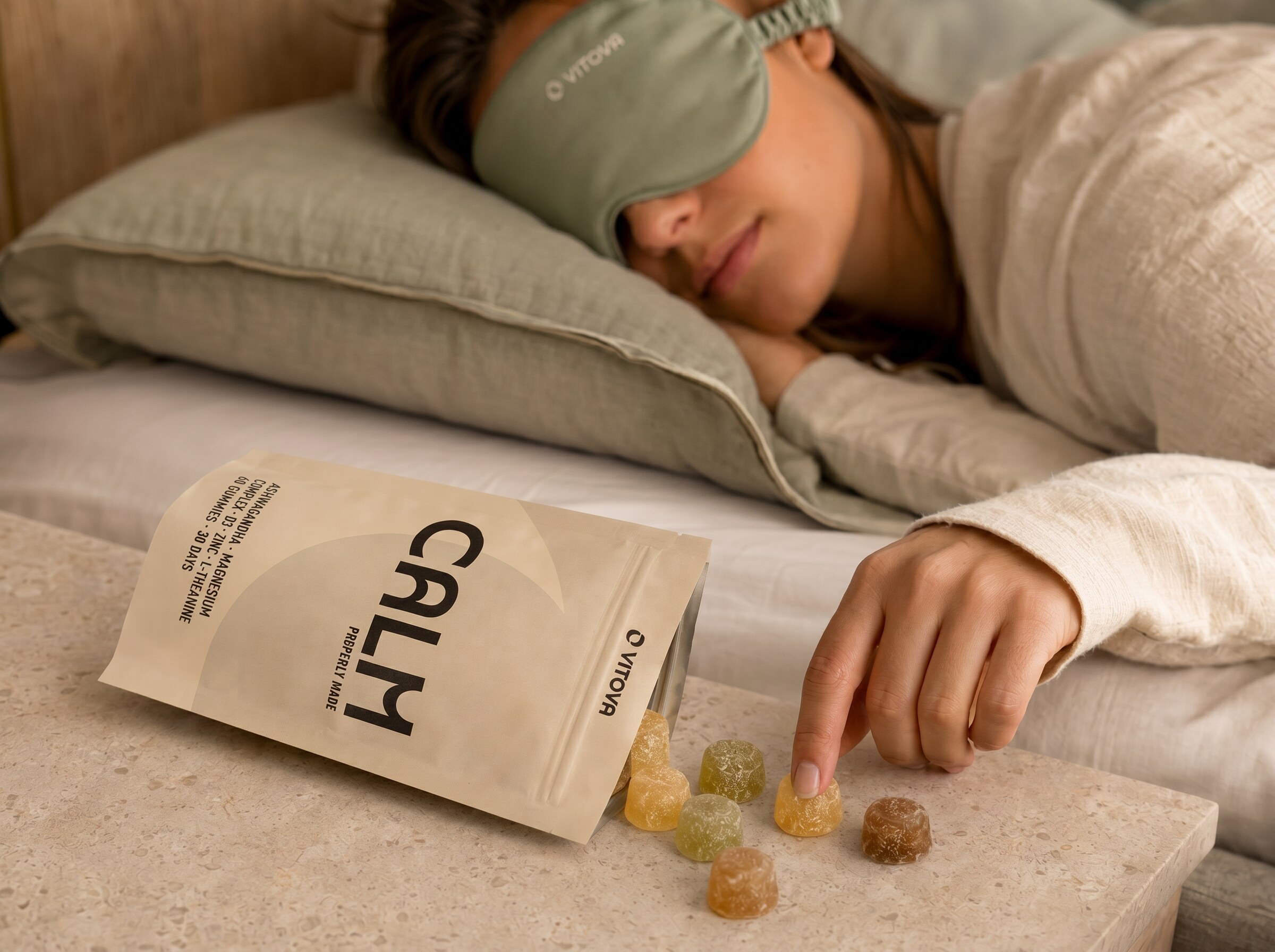
I take it every night, inside the Vitova Calm stack, not as a standalone. I've been on it long enough now to have the boring bit — the plateau — where I don't feel it doing anything on a given day, but if I run out for a week I notice my sleep gets lighter and my mornings get scratchier. That's roughly how it should feel if it's working: quietly, in the background, over weeks. Not a "wow" moment. More like taking the edge off the ambient noise.
I can't run a placebo trial on myself. Whether the improvement is ashwagandha, magnesium, L-theanine, the routine or all of it together — I'll take it either way. But of the four supplemental ingredients in my nightly stack, ashwagandha is the one doing the slow, structural work on the stress side. The others are for symptoms; this is for the system.
Why ashwagandha is in Vitova Calm
Being straight with you: our formula uses ashwagandha at the lower end of the clinical range, not the higher end. That's a deliberate choice with a real trade-off.
Vitova Calm is a stack, not a single-ingredient hero. Ashwagandha addresses the slow, background cortisol side of stress. L-theanine works on the acute, in-the-moment mental noise. Seven forms of magnesium cover the sleep and muscle-relaxation side. Vitamin D3 and zinc do the boring, foundational work that makes everything else land better.
The trade-off is honest: if you wanted the exact dose from the Chandrasekhar trial and nothing else, you'd buy a dedicated 600 mg KSM-66 capsule, take it religiously for 60 days, and skip everything else. That's a legitimate option. Vitova Calm is for the person who'd rather cover the whole stress-and-sleep picture in one gummy they'll actually take every night — without added sugar, without four different bottles on the counter — and let the ingredients work together over weeks. Different problem, different solution.
How I'd approach it if I were starting today
If I hadn't built Vitova Calm and one of my crew asked me how to try ashwagandha for stress properly, here's what I'd tell them:
- Sort the basics first. Caffeine after 3 p.m., alcohol on weeknights, an actual wind-down routine. Ashwagandha on top of a chaotic day drinking six coffees is like putting a good tyre on a broken aircraft — you're solving the wrong problem
- Pick a real dose. 300–600 mg/day of a named standardised extract. Not "1,500 mg of root powder blend"
- Give it 8 weeks. Diary a check-in date. Don't stop after ten days because you don't feel it. Very few people feel it in ten days
- Track what you'd notice. Sleep onset, night waking, resting heart rate in the morning, general sense of edge or no-edge. Numbers, not vibes
- Stop if it doesn't help. Some people are non-responders. That's fine. It's information, not failure
So — do they actually help with stress?
Yes, ashwagandha gummies can genuinely help with stress. But only if:
- The product uses a standardised extract, not just root powder
- The daily serving gets you into the 250–600 mg range, or the ashwagandha sits inside a well-designed stack pulling in the same direction
- You take it consistently for at least 8 weeks — not as a "big meeting tomorrow" one-off
- You're not in one of the groups who should avoid it, and you're comfortable with the sugar load if any
They won't:
- Fix burnout, clinical anxiety, or an overloaded life
- Deliver an acute hit of calm 20 minutes after chewing
- Replace the boring basics — sleep, alcohol, caffeine, daylight, movement
If that sounds underwhelming compared to the TikTok pitch, good — that's the correct expectation. Ashwagandha at its best is a quiet, slow, background-level lever. The kind that shows up in six weeks of "I actually feel better" rather than a first-night miracle. Used properly, that's genuinely valuable. Used as a magic sweet, it's a disappointment waiting to happen.
Choose the format you'll actually stick to. Read the label. Give it eight weeks. Then decide.
Food supplements are not a substitute for a varied, balanced diet and a healthy lifestyle. Ashwagandha is not recommended during pregnancy or breastfeeding, or for people with thyroid disorders, autoimmune conditions, or liver disease. Stop use and speak to your GP if you notice symptoms such as yellowing of the skin or eyes, dark urine, unusual tiredness, or upper-right abdominal pain. If you have a medical condition or take prescription medication, speak to your GP before starting any new supplement.