
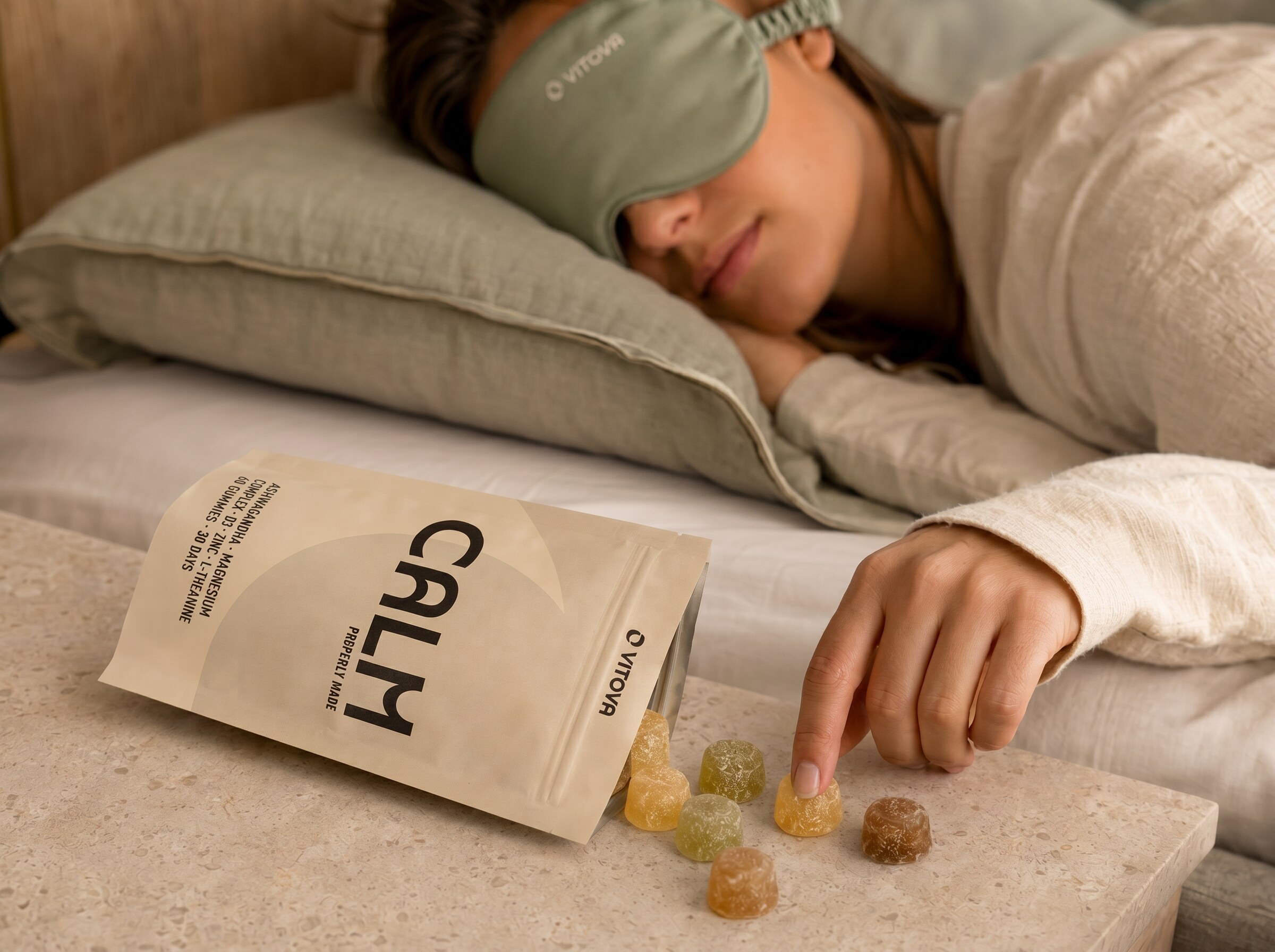
If you've been anywhere near "wellness TikTok" in the last year, you've been sold L-theanine gummies as a magic little green-tea sweet that dissolves stress and gently floats you off to sleep. Chew one, feel calm. That's the pitch.
The truth, as usual, is more interesting — and more useful — than the marketing.
L-theanine is one of the three supplements in my own nightly stack, alongside magnesium and glycine. So I've read a lot of the research and spent a lot of nights being my own guinea pig. Here's my honest take on whether L-theanine gummies actually do anything, and what to look for if you're going to use them.
What L-theanine actually is
L-theanine is an amino acid found almost exclusively in tea leaves — it's a big part of why a cup of green tea makes you feel alert but not jittery.
In the body, it does a few well-documented things:
- Increases alpha brain-wave activity, which is associated with a state of "wakeful relaxation"
- Nudges neurotransmitters like GABA, dopamine and serotonin in the direction of calm
- Blunts the physical stress response — heart rate and cortisol under pressure
Notice what's not in that list: L-theanine is not a sedative. It doesn't knock you out. The Cleveland Clinic puts it plainly — "it's not a sleep aid in the traditional sense: it hasn't been shown to induce sleep directly."
What it does is take the edge off. And for a lot of people, especially those whose sleep problem is really a "can't switch my brain off" problem, that edge is the whole issue.
What the research really shows
This is where I have to be careful. As a UK supplement brand, I can't make health claims. But I can point you at the published science.
The most useful recent piece of work is a 2025 systematic review in Nutritional Neuroscience pooling 13 trials in 550 people. Their headline conclusion:
Supplementation with 200–450 mg/day of L-theanine appears to be a safe and effective way to support healthy sleep in adults.
Other reviews and clinical guides land in almost exactly the same place:
- Stress and everyday anxiety: 200–400 mg/day, typically shows up within 2–4 weeks
- Sleep quality: 200–450 mg/day, taken 30–60 minutes before bed
- Acute stress (a big meeting, a flight, a difficult conversation): a single 200 mg dose about 30–45 minutes before
The pattern that keeps appearing in the trials is not "L-theanine put me to sleep." It's this: people fall asleep a bit quicker, wake up less during the night, and feel more rested in the morning — mostly because they're less wound up going into bed in the first place.
That is a real, useful effect. It's just not the fairy-dust effect the ads suggest.
So where do gummies fit in?
Now the honest question: does putting L-theanine into a gummy change any of this?
There are two things going on that pull in opposite directions.
The good side of gummies:
- People actually take them. If you enjoy your supplement, you don't skip it — and consistency is where any of this has a chance to work.
- They're easy at night. No glass of water, no big capsule when you're already half in bed.
- For people who hate pills full stop, a gummy might be the difference between "on my bedside" and "back of the cupboard, forgotten."
The less flattering side:
- Gummies are small, so the dose per gummy is often small too. Many products give you 50–100 mg per gummy, meaning you need two or even three to get anywhere near a clinically studied dose.
- To taste good, most gummies need sugar or sweeteners — sometimes a surprising amount for something you're taking last thing at night. Vitova Calm has no added sugar, which is one of the non-negotiables I set when we formulated it.
- Ingredient science site Examine and several manufacturer-independent reviews note that gummies tend to sit at the lower end of bioavailability compared to capsules, because there's a smaller active-ingredient-to-filler ratio in each piece.
None of that makes gummies useless. It just means "L-theanine gummy" is not automatically the same as "clinically studied L-theanine dose."
A quick note on Vitova Calm specifically, because I want to be straight with you: the L-theanine content in our gummies sits at the lower end of the clinical range on its own. The reason I'm still happy with the formulation is that L-theanine isn't doing the job by itself — it's stacked with seven forms of magnesium, ashwagandha, vitamin D3 and zinc, so the calm-and-sleep support comes from the whole formula working together, not from one ingredient trying to carry it alone. That's the trade-off we chose: broader stack, no added sugar.
The two questions I ask about any L-theanine gummy
1. What's the real L-theanine dose per serving?
The single most common mistake I see is people taking one gummy, expecting a research-grade effect from a research-grade dose, and getting neither.
Before you buy, look at the back:
- How many mg of L-theanine are in one gummy?
- How many gummies is the "recommended daily serving"?
- Does that add up to at least 200 mg?
If the whole daily serving gives you 100 mg or less, you're at the very bottom of the range studied for sleep. You might feel a subtle nudge. You might feel nothing. You shouldn't be surprised if it's the latter.
2. How much sugar are you eating before bed?
This is the one that gets glossed over in every glossy ad I see.
Two gummies before bed, night after night, can quietly add up to:
- 4–8 g of sugar (roughly 1–2 teaspoons)
- Or an unnecessary hit of sugar alcohols and sweeteners
- Plus colourings, glazing agents and preservatives
If you're already brushing your teeth, doing a wind-down routine and generally trying to eat well, chewing sweets on top of all of that is not a small detail. It's not the end of the world either — but I want to know exactly what I'm signing up for.
This is exactly why Vitova Calm has no added sugar. If you're taking something every night to help you wind down, the last thing you want is a hidden dessert going with it.
My personal test: would I be happy giving this to my own body every night for a year? If the sugar and additives make me hesitate, that tells me something.
How I actually use L-theanine
For context, my sleep story is not "wired 20-year-old who can't switch off." I'm a captain flying a five-day rotating pattern. My body has been shaped by years of early alarms, long-haul time zones and shift work. My main problem was — and to some extent still is — waking up too early with a busy mind.
Here's what genuinely moved the needle for me, before we even talk about L-theanine:
- No coffee after 3 p.m.
- Last meal at least three hours before bed
- A proper wind-down routine — hot chocolate, a book, hot shower
- Almost cutting out alcohol, especially on work nights
On top of that, I run a small, deliberate supplement stack: magnesium, L-theanine and glycine. L-theanine's job in that stack is very specific — it's not there to knock me out. It's there to quiet the mental noise that used to keep me half-awake at 3 a.m. running through tomorrow's flight plan in my head.
Does it work? Honestly, I can't isolate it to any single night. What I can say is that since building the routine and the stack, my sleep is better and my baseline stress at bedtime is much lower. L-theanine feels like one of the more subtle levers — you don't feel a "hit," you just notice you were less on-edge than you'd expected to be.
So — do L-theanine gummies actually work?
My straight answer:
Yes, L-theanine gummies can work — but only if:
- The daily serving lands you in the 200–400 mg range, or the L-theanine is stacked with other well-chosen ingredients (like magnesium, ashwagandha, D3 and zinc) so the whole formula does the work together
- The sugar and additive load is something you're genuinely comfortable eating every night — ideally, no added sugar at all
- And you take them consistently, as part of a proper wind-down routine, not as a magic sweet
They are not:
- A sedative
- A fix for long-standing insomnia
- A replacement for basics like caffeine timing, alcohol, light exposure and stress management
- A miracle cure for a chronically overloaded life
What they are, at their best, is one small, enjoyable way to nudge your nervous system towards calm before bed — for the group of people who would rather chew something than swallow a capsule.
Building a realistic calm stack
Whether you go with gummies, capsules or nothing at all, I think about "calm" the same way I think about sleep — as a series of small, stackable advantages, not one silver bullet:
- A consistent wind-down routine you actually keep to
- A sensible caffeine cut-off
- Minimal alcohol, especially on weeknights
- Cool, dark, quiet bedroom
- Supplements that support relaxation — for me: magnesium, L-theanine, glycine
L-theanine belongs firmly in that toolkit. Gummies are just one delivery format for it. If chewing a well-formulated, well-dosed, properly tested gummy is what actually gets you to take L-theanine every night, that's a win. If you'd happily swallow a clean 200 mg capsule and skip the sugar, that's a win too.
My final take
If a friend asked me, "Should I try L-theanine gummies?" my honest reply is:
L-theanine is genuinely one of the most interesting, well-researched calm-and-sleep ingredients out there. Gummies can be a lovely way to take it — as long as you're getting a real dose, you're happy with the sugar, and the brand can show you what's actually in the pot. Get the routine right first, then let L-theanine be one of the quiet levers that makes the rest of the stack work a little better.
Not a magic sweet. Just a decent tool used properly.
Food supplements are not a substitute for a varied, balanced diet and a healthy lifestyle. If you have a medical condition or take prescription medication, speak to your GP before starting any new supplement.