
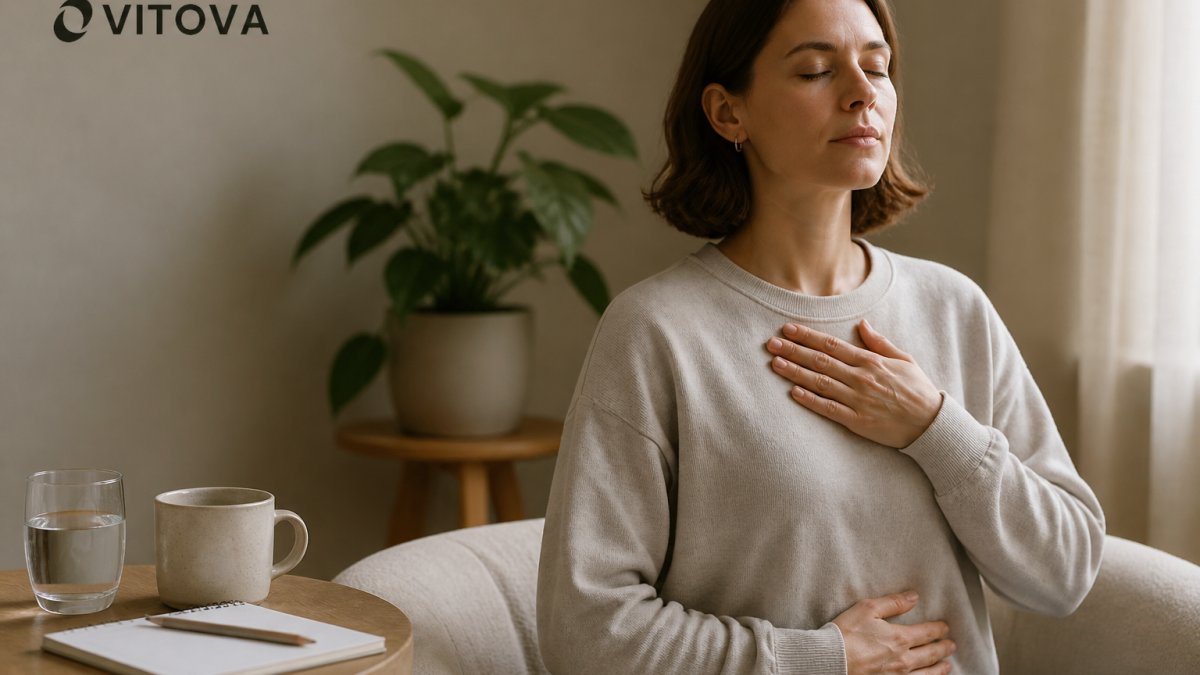
Last Updated: October 23, 2026
Quick Summary
Breathing exercises for anxiety and panic give you a steady rhythm to follow when your breathing turns fast and high in the chest. Simple options like pursed-lip breathing and longer exhalations suit rising panic, while box breathing and 4-7-8 work better when you are calm but tense. They help you steady yourself during stress, but they do not stop panic attacks or replace treatment.
- Pick your technique before you need it, because choosing mid-panic rarely works.
- Box breathing uses equal counts of four for in, hold, out and hold, repeated four to six times.
- The 4-7-8 technique breathes in for four, holds for seven and exhales for eight, repeated four times.
- Panic peaks and then falls, and most surges ease within a few minutes.
- Practise once or twice a day for a few minutes while calm to build the habit.
Table of Contents
- Why Breathing Exercises Can Help With Anxiety and Panic
- Breathing Techniques for Panic Attacks: How to Choose One
- Box Breathing for Anxiety: Step by Step
- The 4-7-8 Breathing Technique Explained
- Pursed-Lip Breathing and Longer Exhalations
- How to Calm Down During a Panic Attack
- Staying Safe: When to Stop and When to Get Help
- Building a Practice Plan and Tracking Progress
- Frequently Asked Questions
Why Breathing Exercises Can Help With Anxiety and Panic
Breathing exercises for anxiety and panic work because they give you something steady to follow when everything else feels fast and loud. This guide from Vitova explains the techniques that help most, how to use them safely, and what to do when they do not settle things.
The basic idea is simple. Anxious breathing tends to sit high in the chest and run quick. Slow, steady breathing gives your body a slower rhythm to copy. The NHS advice on breathing exercises for stress describes this as a way to help you feel more in control during stressful moments.
What breathing will not do is switch off anxiety like a light. It is a tool, not a cure.
What the evidence does and does not show
Breathing techniques are widely used and generally low risk, but the evidence is not as strong as headlines suggest.
- What it can do: help you steady yourself during stress or a panic attack, and give you a sense of control.
- What it cannot do: stop panic attacks from happening, or replace treatment for an anxiety disorder.
- What is unclear: how much of the benefit comes from breathing itself versus slowing down and paying attention.
If you are weighing up calming approaches more broadly, it helps to see what the evidence says about L-theanine before adding anything to your routine.
Breathing Techniques for Panic Attacks: How to Choose One
Breathing techniques for panic attacks are not one-size-fits-all. The right choice depends on how panicked you feel and where you are.
A common mistake is trying a complex counting pattern mid-panic. Counting takes focus, and focus is the first thing panic takes away. Start with the simplest option that fits the moment.
Matching the technique to the moment
| Situation | Try this | Why it fits |
|---|---|---|
| Early signs of panic | Pursed-lip breathing | Simple, no counting, works while walking |
| Panic already rising | Longer exhalations | Slows the breath without mental effort |
| Calm but tense | Box breathing | Structured counting suits a settled mind |
| Winding down at night | 4-7-8 breathing | Slow rhythm supports relaxation |
Box Breathing for Anxiety: Step by Step
Box breathing for anxiety is a square pattern: breathe in, hold, breathe out, hold, each for the same count. It suits moments when you are tense but not overwhelmed.
- Sit comfortably with both feet on the floor.
- Breathe in through your nose for four counts.
- Hold gently for four counts.
- Breathe out slowly for four counts.
- Hold for four counts.
- Repeat the cycle four to six times.
Keep the holds comfortable, never strained. If holding your breath makes you tense, skip the holds and focus on the even in-and-out rhythm instead.
The 4-7-8 Breathing Technique Explained
The 4-7-8 breathing technique uses a longer exhale than inhale. Breathe in for four counts, hold for seven, then out for eight.
The long exhale is the point. A slower out-breath tends to feel more settling than a long in-breath, which is why many people prefer this pattern for winding down.
Try it sitting or lying down, with your mouth closed and tongue resting gently. Repeat the cycle four times. If seven and eight feel too long, shorten them and keep the ratio: out should be longer than in.
Pursed-Lip Breathing and Longer Exhalations
Pursed-lip breathing is the simplest technique here, and often the easiest to use in public. Breathe in through your nose for two counts, then out through pursed lips for four.
That is the whole method. No counting to seven, no holding. It works while walking, queuing, or sitting at a desk.
Longer exhalations help because they slow the breath cycle without asking much of you. The aim is a gentle, steady rhythm, not a deep breath you force. Forcing big breaths can make you feel lightheaded, which feeds panic rather than calming it. (Source: The Mental Health Foundation's guidance on managing stress)
How to Calm Down During a Panic Attack
Knowing how to calm down during a panic attack starts with one fact: panic peaks and then falls. It feels permanent while it is happening. It is not. Most panic surges ease within a few minutes, even though the after-effects can linger.
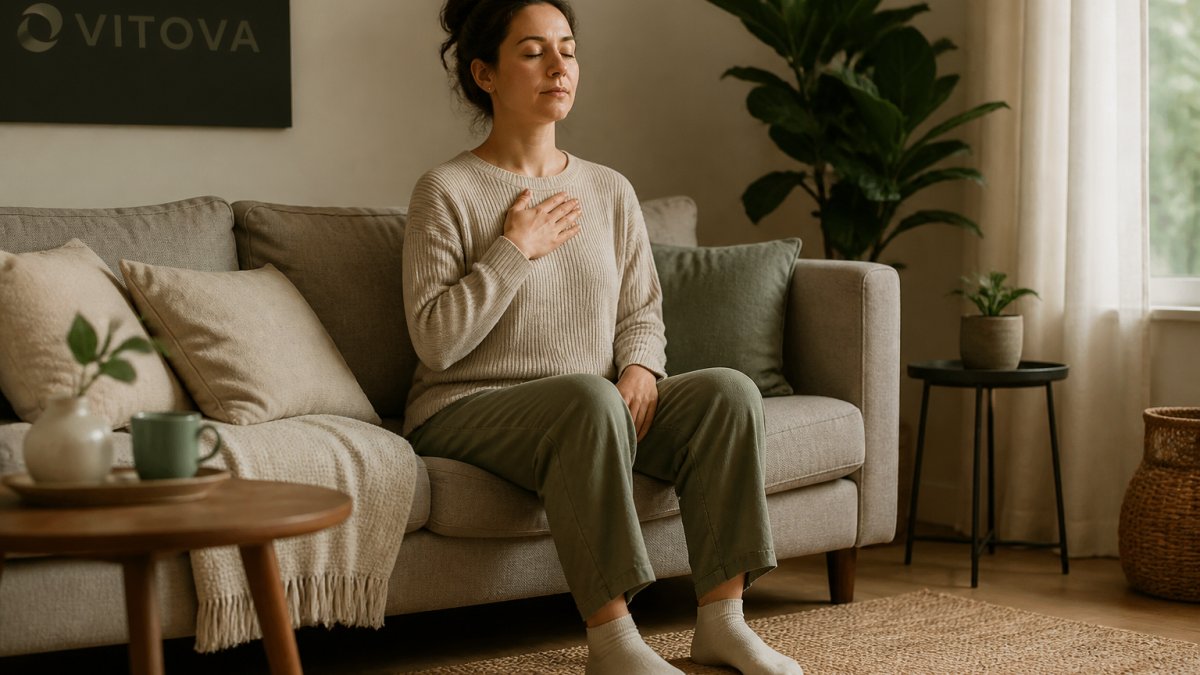
Work through these in order, and stop at whichever step settles you:
- Sit down and put both feet flat on the floor. Feeling the ground under you is a simple anchor.
- Name five things you can see, four you can hear, and three you can feel. This is grounding, and it works alongside breathing rather than instead of it.
- Switch to pursed-lip breathing, out for longer than in. Keep it gentle.
- Release tension in your shoulders, jaw and hands. Panic tightens these without you noticing.
- Stay with the slow rhythm until the wave passes, then return to normal breathing.
Why very deep breaths can make panic worse
A common misconception is that a panic attack means you are not getting enough air, so the fix is to breathe as deeply as possible. For many people the opposite is true. Over-breathing (sometimes called hyperventilation) lowers carbon dioxide in the blood, which can cause dizziness, tingling in the fingers and lips, and a faster heart rate. Those sensations are easy to read as proof that something is badly wrong, which feeds the panic loop.
The aim is not a huge breath. It is a gentle, steady one, with an out-breath slightly longer than the in-breath. If you feel lightheaded, stop the technique and breathe normally until the feeling passes.
If breathing makes it worse
For some people, focusing on the breath during a panic attack draws attention to the very sensations that feel frightening. If that happens, switch to a grounding approach instead: press your feet into the floor, hold something cold, or describe your surroundings out loud. Breathing exercises are one coping tool, not the only one, and it is fine to set them aside in the moment and practise them later when you are calmer.
Grounding and breathing work well together. If you want more techniques for the moment itself, this guide on how to calm down after work covers quick ways to unwind when stress has built up.
Staying Safe: When to Stop and When to Get Help
Breathing exercises are low risk for most people, but stop if you feel dizzy, faint, or more panicked than when you started. That is a sign the pace is too fast or the holds too long. Go back to a gentle, natural breath.
Seek medical advice if you have a heart or lung condition, are pregnant, or panic attacks are frequent. Speak to your GP if anxiety is affecting your daily life. Breathing exercises sit alongside professional support, not in place of it. Never change prescribed medication without talking to your doctor.
Building a Practice Plan and Tracking Progress
Breathing exercises work best as a habit built while calm, not a rescue attempt mid-panic. Practise once or twice a day for a few minutes, at a fixed point in your routine, so the pattern is familiar before you need it.
- Week 1: pursed-lip breathing, two minutes, twice daily. Keep it simple and get the out-breath longer than the in-breath.
- Week 2: add box breathing for four cycles, only if the holds feel comfortable.
- Week 3: try 4-7-8 in the evening, shortening the counts if seven and eight feel strained.
- Ongoing: rotate the technique that suits each situation, and note which one helped and when.
What to track, and why
A simple note on your phone is enough: date, technique, how you felt before and after, and whether you stopped early. Patterns show up fast. You may find, for example, that pursed-lip breathing helps on a busy commute but box breathing feels easier at bedtime. Tracking comfort and frequency matters more than tracking a score, because the aim is a tool you will actually use, not a target to hit.
When breathing exercises do not help
Not everyone finds breath focus calming, and that is worth saying plainly. If a technique makes you dizzy, breathless, or more panicked, stop and return to normal breathing. If breathing exercises consistently do not settle you, or anxiety is affecting your daily life, speak to your GP (the NHS). They can discuss options including talking therapies, and breathing practice sits alongside professional support rather than in place of it.
Other approaches are worth trying alongside breathing: gentle movement, grounding techniques, and a steady sleep routine. If you are building a wider daily routine, some people also look at supplement options. Vitova Calm combines magnesium, ashwagandha, L-theanine, zinc and vitamin D3 in a two-gummy daily format, with full ingredient details on its product page.

For a broader set of practical, non-medication approaches, see how to calm anxiety naturally.
Frequently Asked Questions
What breathing technique can help during a panic attack?
Slower breathing with a longer exhalation than inhalation is the gentlest starting point, and pursed-lip breathing is a simple version: breathe in through your nose, then out through softly pursed lips for roughly twice as long. Box breathing and the 4-7-8 technique suit some people but can feel effortful mid-panic. If counting makes you more tense, drop the count and simply make each out-breath slightly longer. Stop if you feel dizzy and return to normal breathing.
Should I breathe in through my nose or mouth when I feel anxious?
Nose breathing is usually the better default because it warms, filters and humidifies the air. Mouth breathing is fine if your nose is blocked or you have a cold. During a panic attack, some people find a blocked nose adds to the sense of struggle, so use whichever route lets you breathe gently without strain. The important part is the pace and the longer exhalation, not the route.
Can breathing exercises make panic symptoms feel worse?
Yes, and this is common enough to be worth knowing in advance. Deliberately deep or fast breathing can lower carbon dioxide levels and cause dizziness, tingling and light-headedness, which can feel like panic symptoms. Counting and holding can also add pressure. If a technique makes you more anxious, stop, breathe normally for a minute, and try a gentler option such as pursed-lip breathing or simply lengthening your out-breath.
How long should I practise a breathing exercise, and when should I seek help?
Short and regular beats long and occasional: a minute or two, once or twice a day, is a reasonable starting point, building to around five minutes. Practise when you are already calm so the technique is familiar when you need it. Speak to your GP if panic or anxiety is affecting your work, sleep or daily life, if attacks are frequent, or if you are avoiding situations. Breathing exercises are a self-management tool, not a treatment for an anxiety disorder.
Breathing exercises are a skill, and like any skill they need practice before they work under pressure. Start with one technique, use it daily, and build from there. Vitova makes Calm as a simple two-gummy daily ritual for busy routines, with a 30-day supply per pouch and no synthetic colours or fillers. Explore the verified product details and see whether it fits alongside your breathing practice.



Leave a comment
This site is protected by hCaptcha and the hCaptcha Privacy Policy and Terms of Service apply.